”The way Hispanic media is structured matters as much as where it runs.”
Our Capabilities
Media Strategy & Market Architecture
Audience definition, market prioritization, and strategic planning aligned with business objectives.
Integrated Media Activation
Coordinated execution across relevant channels — including audio, digital, CTV/OTT, OOH, and influencer ecosystems — based on strategic fit, not inventory.
Hispanic Market Execution Partner
Coordinated execution across relevant channels — including audio, digital, CTV/OTT, OOH, and influencer ecosystems — based on strategic fit, not inventory.
Measurement & Optimization
Continuous performance analysis to improve efficiency, coherence, and return on investment.
Radio Campaign Management
When Hispanic growth depends on trust, frequency, and cultural relevance, radio remains one of the most effective ways to build presence and drive response.
Campaign support includes planning, negotiation, contracting, and coordination across Mexico and the southern United States — with execution designed around audience fit, market priority, and campaign goals.
Rather than treating radio as a standalone buy, the objective is to use it where it can create meaningful reach, stronger recall, and more efficient market penetration.
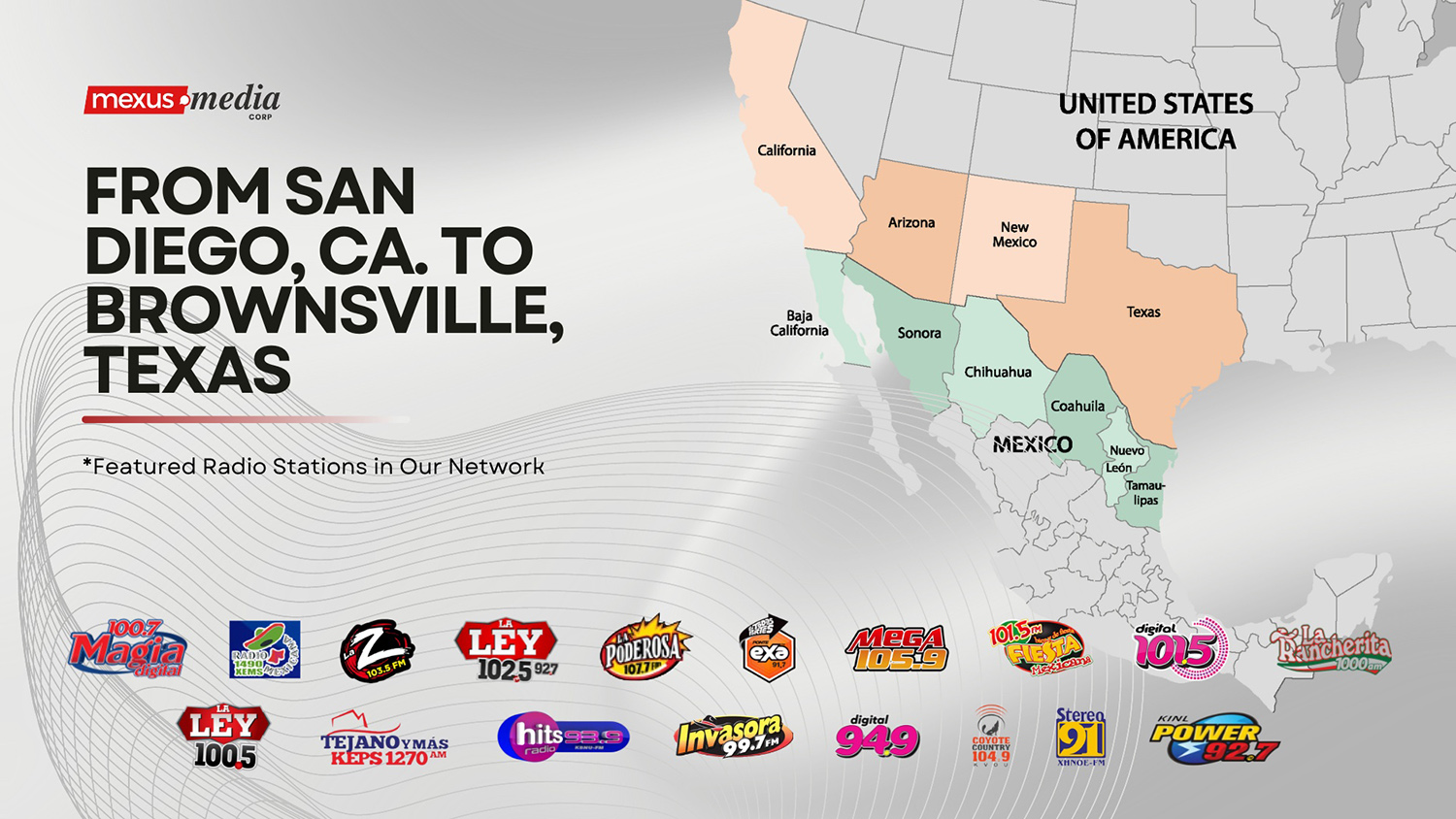
From San Diego, California to Brownsville, Texas, campaigns can be activated across a network of stations selected for audience relevance, local strength, and regional coverage.
This reach allows brands to build stronger visibility across key border markets where Hispanic audiences are especially important to growth.
Execution can extend across major Hispanic markets including San Diego, El Paso, McAllen, San Antonio, Houston, Dallas, Phoenix, Chicago, Los Angeles, and Miami.
The value is not just presence in those cities.
It is the ability to align market selection with campaign priorities and audience relevance.
When the strategy requires cross-border scale, campaigns can also extend across a Latin American portfolio of more than 1,200 radio stations.
Coverage spans multiple formats and audience profiles, allowing media plans to be shaped around market needs, territory, budget, and expected impact.
The value is not access alone.
It is using that access with clearer market logic.
Crossmedia
Hispanic audiences do not experience media in silos. That is why stronger performance often comes from connecting channels, not isolating them.
Crossmedia strategies combine online and offline environments to improve coordination, reinforce the message, and increase campaign effectiveness across the customer journey.
This can include digital amplification, content management, creative development, and campaign integration — always tied to the role each channel should play within the broader strategy.
Selected Work
Broxel Remittance Product Launch
Broxel’s remittance product launch needed stronger positioning and broader visibility among Hispanic audiences in the U.S.
Through a collaboration with Piolín’s radio show, the campaign extended across more than 35 cities, helping increase awareness, attract new users, and drive app downloads in a highly competitive category.
2020 U.S. Census
Increasing participation among Hispanic communities in Texas border markets required culturally relevant outreach and trusted Spanish-language media.
Targeted radio campaigns helped raise awareness, improve engagement, and support greater census participation among audiences that are often harder to reach through general market efforts.
Texas Department of Agriculture
Protecting Texas flora and fauna required reaching Spanish-speaking audiences on both sides of the border with a clear public service message.
Through partnerships with Spanish-language radio stations along the southern border, the campaign expanded awareness around the transport of harmful seeds and plants from Mexico and helped deliver that message with stronger local relevance.